What Cinco de Mayo is, and is not
It is the anniversary of one battle on one morning in 1862. It is not Mexico’s independence day, and it is not the biggest date in the Mexican calendar.
What it commemorates
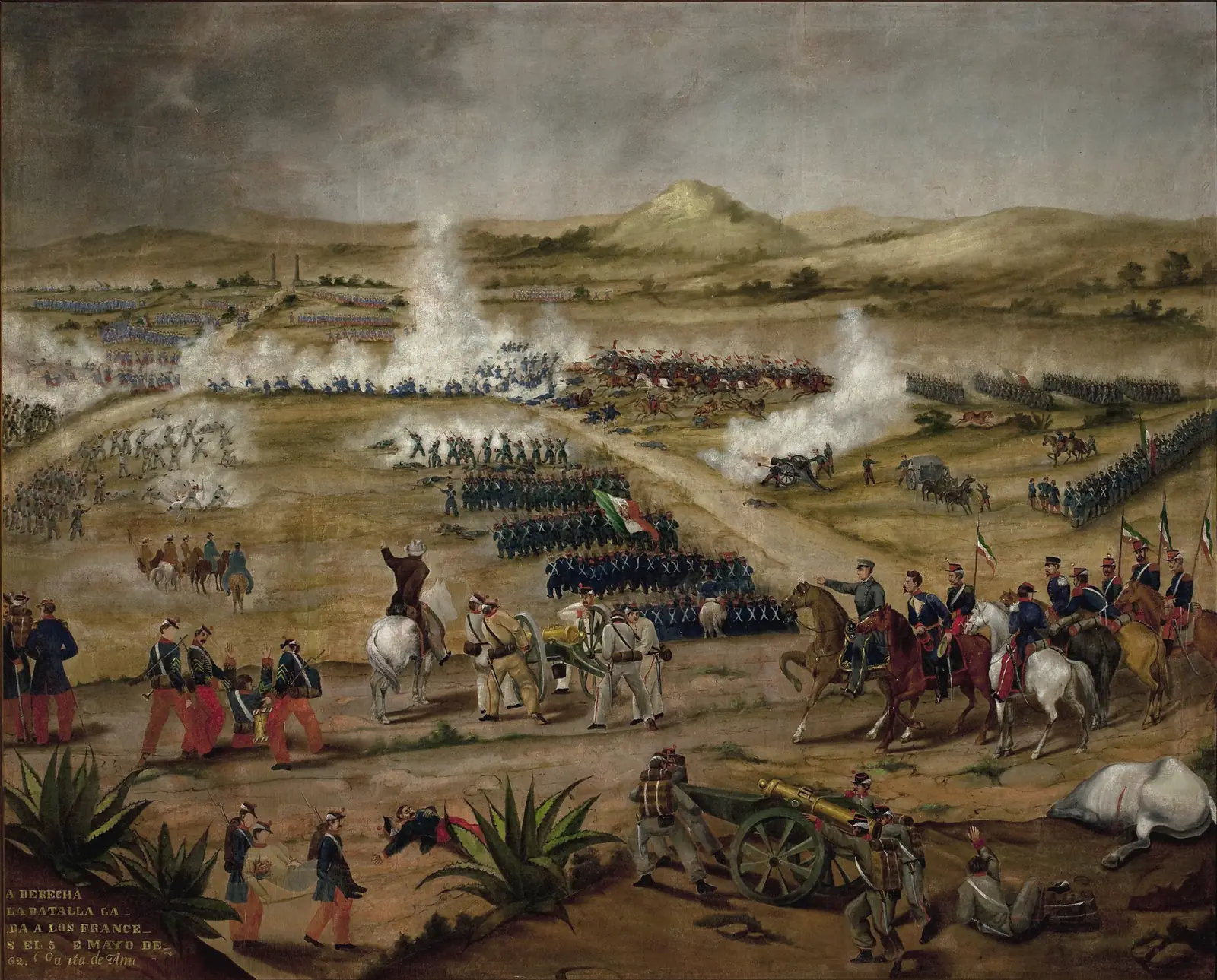
On 5 May 1862 a Mexican army commanded by General Ignacio Zaragoza defeated a French force outside the city of Puebla de Zaragoza. The French were professional soldiers of an empire widely seen as having the best army in the world. The Mexican defenders were outnumbered or at best evenly matched (the sources give different figures), fighting from two hilltop forts.
The French were in Mexico because Napoleon III saw a chance to install a friendly monarchy. The pretext was the debt that Benito Juárez’s government had suspended in 1861. Britain and Spain, the other two creditors, took their settlement and left. France stayed.
The battle was a morale victory more than a decisive one. The French regrouped, returned in 1863 and took Puebla and Mexico City. But 5 May 1862 showed that the intervention could be resisted, and it became the date Mexico remembers. Follow the battle step by step on the 1862 plan.
Sources: Encyclopaedia Britannica; National Geographic History; HISTORY
What it does not
It is not Independence Day
Mexico’s independence from Spain is celebrated on 16 September, the anniversary of Miguel Hidalgo’s Grito de Dolores in 1810, when he called for revolt in the town of Dolores. Independence was achieved in 1821. That is the national holiday, with the president giving the Grito from the balcony of the National Palace on the evening of 15 September.
It is not Mexico’s biggest holiday
In Mexico the fifth of May is a civic commemoration. It is marked most strongly in Puebla, with a military and civic parade and a re-enactment, and it is not one of the statutory national days off. In the United States it has grown far larger as a celebration of Mexican-American culture. See how the two compare.
It is not the end of the war
France came back with reinforcements in 1863. Maximilian of Habsburg was proclaimed emperor in 1864. French troops left in 1867, and Maximilian was executed on 19 June of that year.
Sources: NPR; National Geographic History; Encyclopaedia Britannica
How it became a US tradition
Historian David Hayes-Bautista argues that the first Cinco de Mayo celebrations took place in California in 1862, among Latino communities who felt the French victory as a blow for republicanism while the United States was fighting its own Civil War. Groups raised money for the Mexican cause and held parades and speeches.
The day was revived by Chicano activists in the 1960s, who saw in the Mexican resistance to a foreign power a mirror of their own struggle for recognition. In the 1980s and 1990s brewers and food companies promoted it widely, which is why many people now associate it mainly with margaritas and tacos.
Cinco de Mayo is a Mexican battle anniversary that became, in the United States, a festival of Mexican-American culture. Both things are true, and both deserve to be celebrated accurately.
Sources: University of California Press; TIME; NPR
Frequently asked questions
Is Cinco de Mayo Mexican Independence Day?
No. Mexico’s independence is celebrated on 16 September, the anniversary of the Grito de Dolores in 1810. Cinco de Mayo (the fifth of May) marks a military victory over French troops at Puebla in 1862.
Who won the Battle of Puebla, and did it end the war?
Mexico won the battle. It did not end the war: France returned with a larger army, took Puebla in 1863 and Mexico City soon after, and withdrew only in 1867.
Is it a big holiday in Mexico?
Not nationally. It is a civic commemoration, celebrated most in the state of Puebla with parades and a re-enactment, and most Mexicans work and go to school as usual.
Why is it so big in the United States?
Latino communities in California marked the victory in 1862, Chicano activists revived it in the 1960s, and in the 1980s and 1990s brewers and food companies promoted it widely. It became a celebration of Mexican-American culture.
How do you say it?
“Cinco de Mayo” is Spanish for “fifth of May”. Say it SEEN-koh deh MY-oh.
What should I cook?
Start with the recipes in this guide: guacamole, a charred salsa, tinga poblana, red rice, esquites and two aguas frescas. Puebla’s own dish is mole poblano, which deserves a weekend of its own.
Is it Cinco de Mayo or Cinco de Mayo Day?
Just Cinco de Mayo. In Mexico the date is called “el Cinco de Mayo”, or more formally the anniversary of the Battle of Puebla (Aniversario de la Batalla de Puebla).
Who was Ignacio Zaragoza?
A Mexican general, born in 1829 in what is now Goliad, Texas, then part of Mexico. He commanded the Army of the East at Puebla and died of typhoid in September 1862, aged 33.