The battle, step by step
Ten steps from the debt crisis of 1861 to the fall of the empire in 1867, laid out on the plan of the battle printed in Mexico in 1862.
Interactive battle map
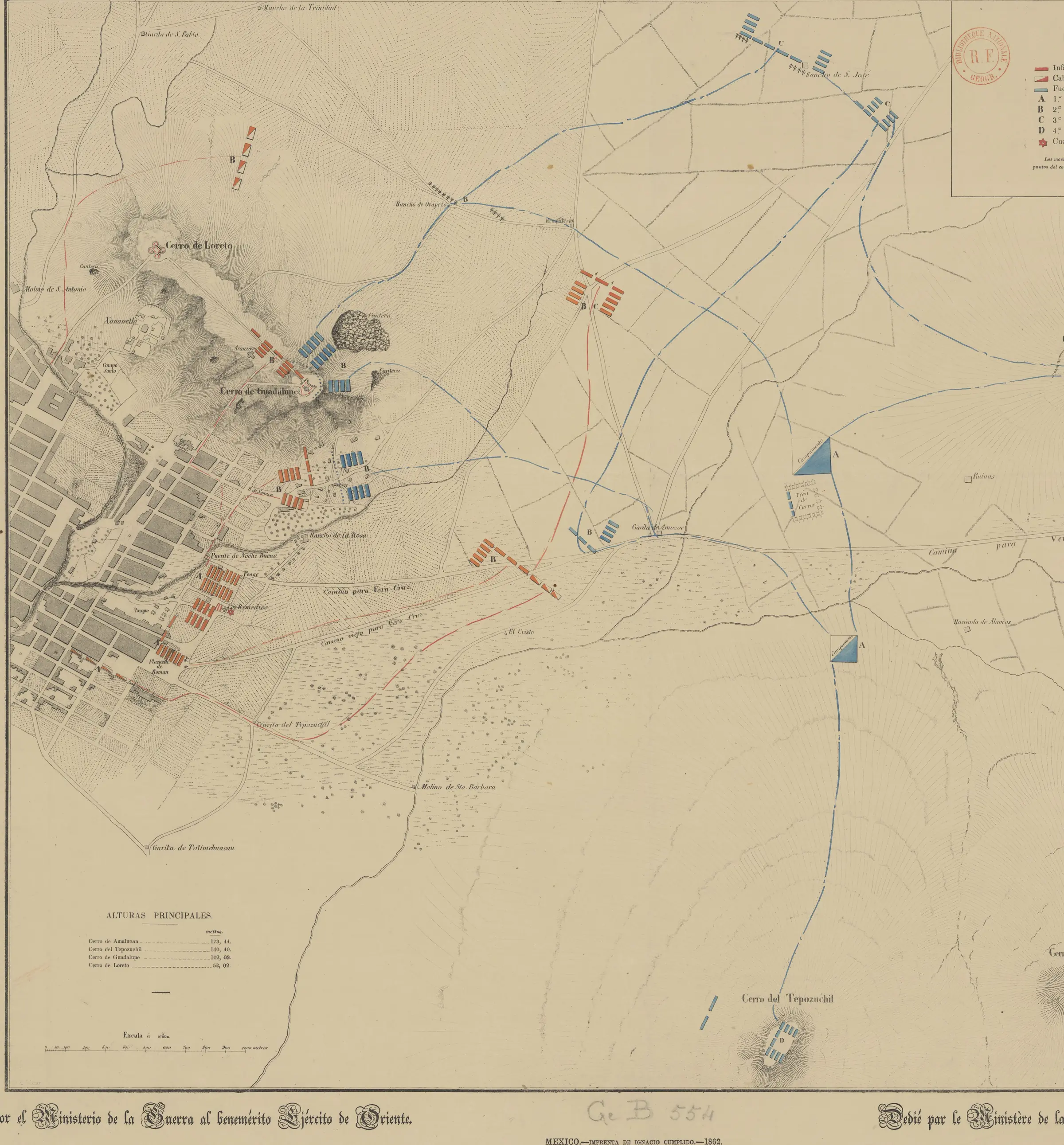
Detail of the plan printed by Mexico’s War Ministry in 1862 (public domain). Red marks Mexican troops, blue French. The markers are our own and approximate; the plan is the authority.
Press the arrows to begin
The map and this card follow the story. Without scripts, read the full timeline below.
The full timeline
The same ten steps in order, for reading straight through.
Mexico suspends debt payments
July to October 1861
After the Reform War, Mexico’s liberal government under Benito Juárez was nearly broke. In July 1861 it suspended payments on its foreign debts.
In October, Britain, France and Spain agreed in London to act together to collect. Only one of the three, France under Napoleon III, wanted more than money.
The allies land, and two of them leave
December 1861 to April 1862
Allied ships landed troops at Veracruz in December and January. Spain and Britain soon reached terms with Mexico and withdrew.
France did not. Its army began to march inland toward Mexico City, along the road that passes through Puebla.
A delaying fight in the mountain pass
28 April 1862
At the Cumbres de Acultzingo, Mexican forces fought the French advance and retreated toward Puebla. It bought time, and Zaragoza used it.
French commander Charles de Lorencez, confident after the easy landing, pressed on.
Zaragoza fortifies the hills above Puebla
1 to 4 May 1862
General Ignacio Zaragoza concentrated the Army of the East in Puebla and made the city defensible. Two old convent and chapel sites on the ridge north of town, Loreto and Guadalupe, became forts about a kilometre apart.
The French arrived on the plain to the east on 4 May and camped within sight of the ridge.
The French attack Guadalupe head on
5 May 1862, morning
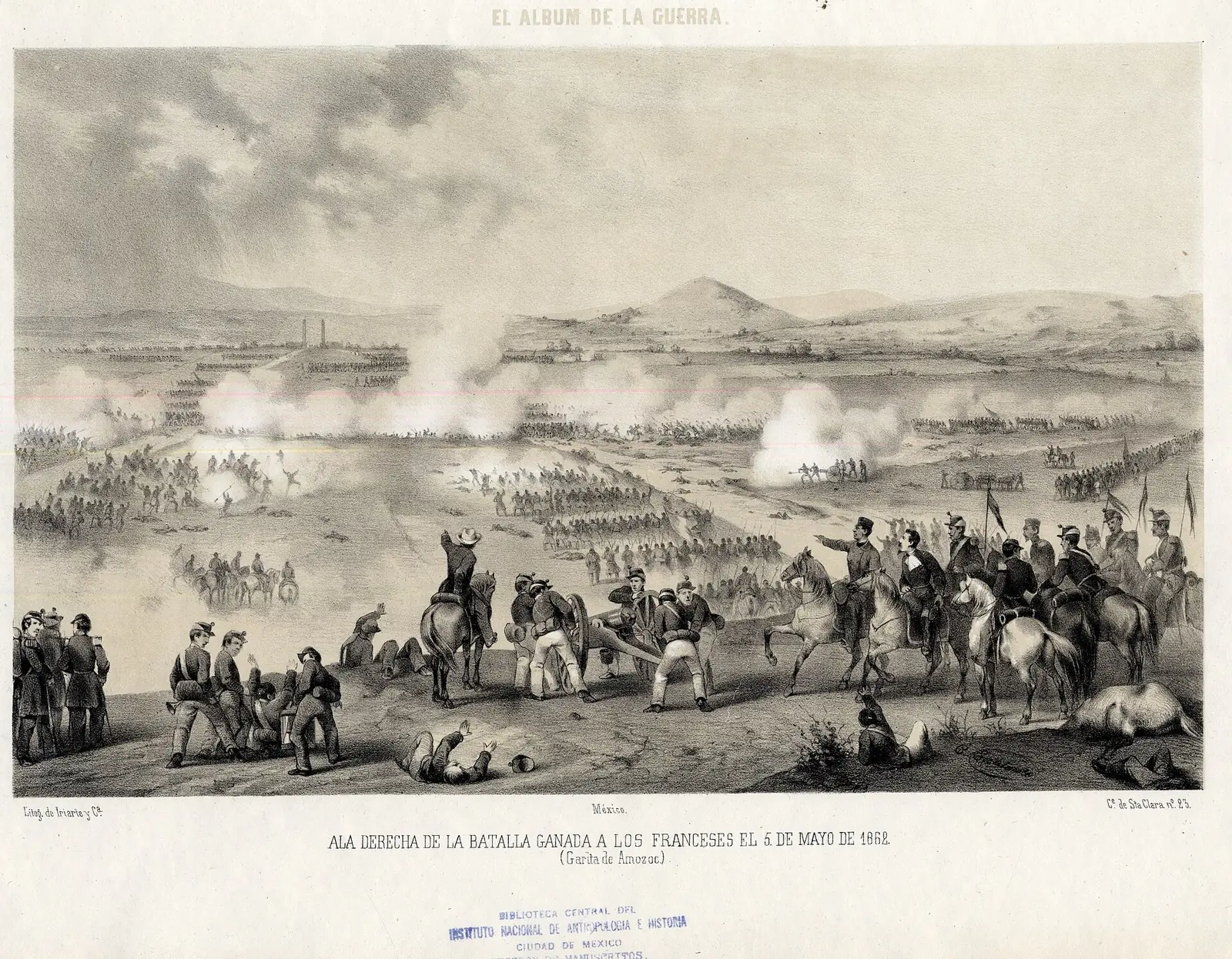
French artillery opened fire from the plain and the infantry advanced on the Cerro de Guadalupe, the stronger approach in French eyes, since Lorencez expected the Mexicans to break quickly.
Sources agree the fighting began in the morning. Britannica describes a frontal assault up the steep hill against a position fortified with a ditch and a brick wall.
The attack is repulsed, again and again
5 May 1862, midday
The French made repeated assaults on the hill and each was thrown back. Mexican infantry and cavalry counterattacked on the flanks; Britannica credits a young officer, Porfirio Díaz, with turning back a flank of the French army.
Accounts also describe rain in the afternoon making the slope hard going for the attackers.
The French withdraw east along the Veracruz road
5 May 1862, evening
By late afternoon the French were falling back. They had lost several hundred men (figures in the sources range from about 450 to about 1,000); Mexican losses were far lighter.
Zaragoza did not pursue in strength. The French fell back toward Amozoc and then the coast to wait for reinforcements.
Zaragoza dies of typhoid
8 September 1862
Ignacio Zaragoza died of typhoid fever on 8 September 1862, aged 33. The city of Puebla was later renamed Puebla de Zaragoza in his honour.
A second, larger French army takes Puebla
March to June 1863
The victory did not end the war. France sent reinforcements, and after a siege of about two months its army took Puebla in May 1863 and entered Mexico City in June.
Maximilian’s empire collapses
1864 to 1867
France installed Maximilian of Habsburg as emperor in 1864. Under pressure from the United States after its Civil War, and from continuing Mexican resistance, France withdrew its troops by 1867.
Maximilian was executed on 19 June 1867. Juárez’s republic was restored, and 5 May 1862 was remembered as the day the intervention first failed.
Sources: Encyclopaedia Britannica; National Geographic History; HISTORY; Library of Congress
Who was who
Ignacio Zaragoza (1829 to 1862)
Born in what is now Goliad, Texas, then part of Mexico, he was a liberal general who commanded the Army of the East. He is the commander most closely tied to the victory and died of typhoid four months later.
Charles de Lorencez (1814 to 1892)
The French general who led the attack on Puebla. His army was confident and he attacked the strongest point of the Mexican line head on; he was replaced soon after the defeat.
Porfirio Díaz (1830 to 1915)
A young Mexican officer in the battle, credited by Britannica with turning back a flank of the French army. He later became president and ruled for much of the period from 1876 to 1911.
Benito Juárez (1806 to 1872)
The president whose suspension of foreign debt payments gave France its pretext, and who led the republic through the intervention to its restoration in 1867.
Sources: Encyclopaedia Britannica; National Geographic History; Library of Congress